
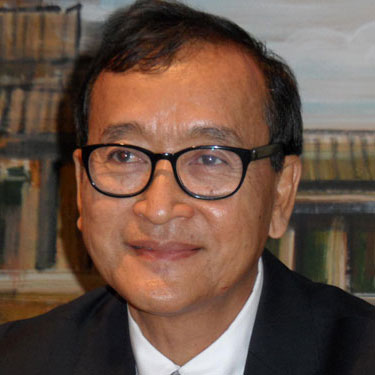
Sam Rainsy
Sam Rainsy, Cambodia’s finance minister from 1993 to 1994, is the co-founder and acting leader of the opposition Cambodia National Rescue Party (CNRP).
Cambodia: Democratic World Must Deny Hun Sen Legitimacy after Election with No Opposition
Two weeks after my article "Cambodia: Government invents red tape to stop opposition registering for election" appeared in The Geopolitics, my worst predictions have come true.
I...
Cambodia: Government Invents Red Tape to Stop Opposition Registering for Election
The Cambodian government is making up new bureaucratic obstacles to try to prevent the risk of any real opposition party being able to contest...
Cambodia: Silenced Kem Sokha Remains Symbol of Democracy
When I resigned from the leadership of the Cambodia National Rescue Party (CNRP) in February 2017, to hand over to deputy leader Kem Sokha,...
Cambodia’s Hun Sen Destroys Last Remnants of Free Press as Elections Approach
Cambodian Prime Minister Hun Sen has shown that he has no intention of allowing the national elections scheduled for July 2023 to be free...
Japan’s Line App Must Not Be Tool of Cambodia’s Dictator Hun Sen
Cambodian Prime Minister Hun Sen has done everything in his power to suppress any sign of opposition to his rule, which has now lasted...
World’s $20 Billion Investment in Cambodia’s Democracy Can Still Be Saved
Since the Paris Peace Agreements (PPAs) on Cambodia in October 1991, the world has poured billions of dollars into the attempt to create a...
Cambodia’s Hun Sen Shows His Weakness With Post-election Repression
Many observers have been surprised by the new wave of political repression which has taken place in Cambodia since the communal elections of June 5.
Prime Minister...
Russia’s War on Ukraine Highlights Global Need to Defend Democracy
Russia's war on Ukraine may prove to be the turning point when the free countries of the world realized that democratic freedoms have to...
Don't miss
Sponsored Post
A Real and Charming China in the Eyes of Taiwan Youths
As the yearning for more cross-Straits communications between the...
Defense
Why Macron Is Thinking About Western Intervention in Ukraine
Emmanuel Macron, the President of France, initially took a...
Middle East and Africa
Ensuring Israeli Security and Palestinian Liberation to Avert World War
The post-October 7 Israel-Hamas war highlights perhaps the sheerest...
Europe
To Secure a Peaceful and Prosperous Future, Women Must Be Included at All Levels
For the first time in our history, Northern Ireland...
Diplomacy
US-China Rivalry and ASEAN’s Fine Balancing Act
In recent years, Association of South East Asian Nations...
